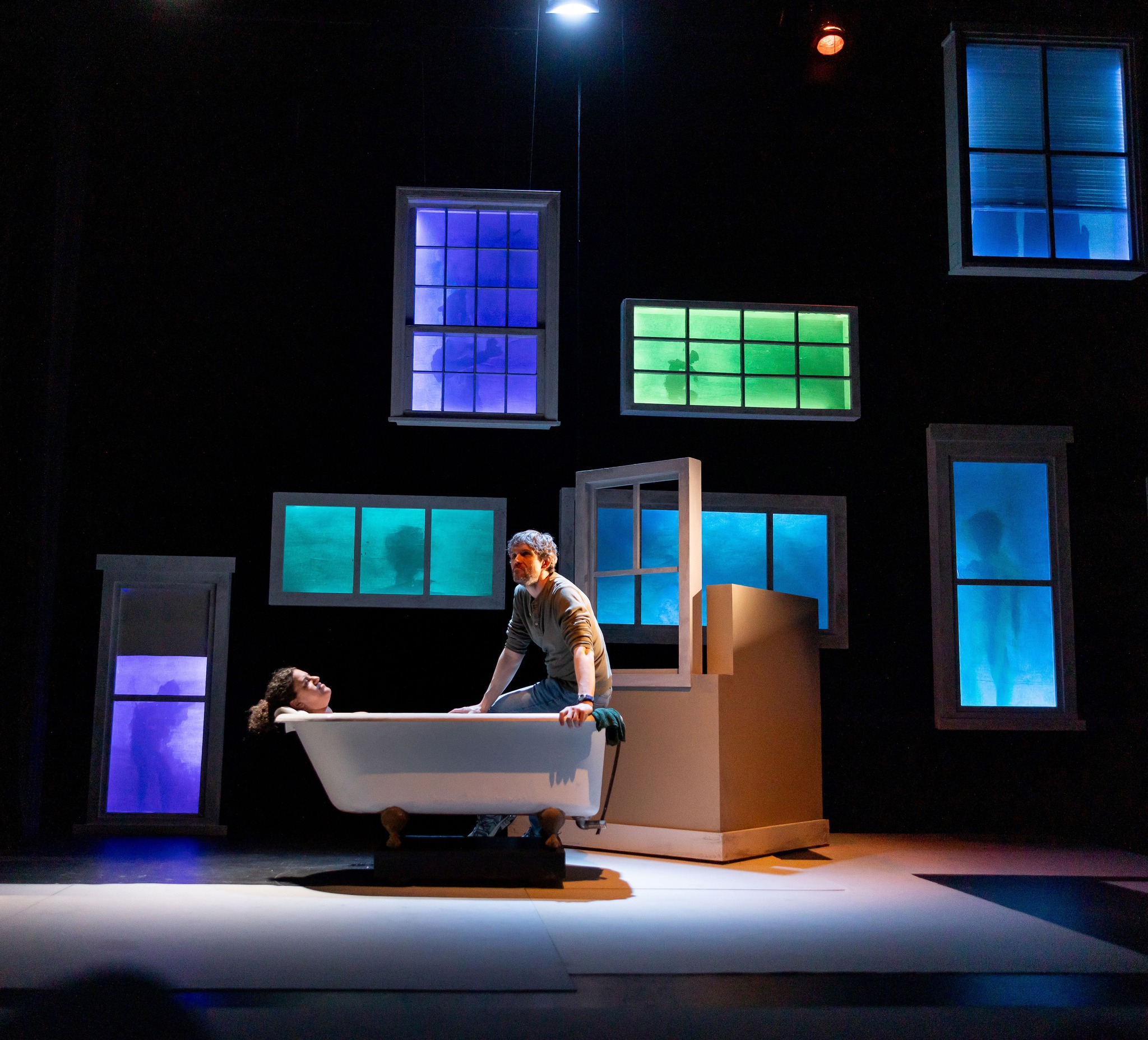
with Lewis D. Wheeler in “Cost of Living” at SpeakEasy Stage in Boston. Photo credit by Nile Scott of Nile Scott Studios
Gould nicely balances Ani’s wrathful force with glimpses of the fear and vulnerability that lie beneath — and there are traces, too, of longing for the marriage that might have been.
With Lewis D. Wheeler in “Cost of Living” at SpeakEasy Stage. Photo by Nile Scott of Nile Scott Studios.
Gould, in my favorite performance of the cast, is wickedly funny and strong-willed as Ani. She’s a true Jersey girl through and through, adept at weaponizing a spiky tongue and a fleet of four-letter words to assert her space and keep others at a comfortable distance.
Ani (a top-notch Stephanie Gould)…Although Gould says she did a lot of hiding when she was growing up because her disability was emotionally and physically painful, she’s more comfortable and confident now. “I want to show people that disabled actors are just as worthy of stage time as ‘normal’ actors,” she told the Boston Globe. After viewing her in ‘Cost of Living,’ it’s clear she has done just that — and more.
As Ani in “Cost of Living” at SpeakEasy Stage in Boston. Photo Credit by Nile Scott of Nile Scott Studios.
Gould is exceptionally funny as the guttural, acerbic, cantankerous, foul-mouthed Ani but she also displays a softer, more vulnerable side as Ani who soon relents to Eddie’s offers of assistance.
The actors vividly construct the dynamic between the two characters, who had been together for almost 21 years before breaking up. The actors’ intense chemistry makes it believable that they must have a past together and are now in a complicated, painful reunion…Ani’s apparent harshness towards Eddie — despite which Gould skillfully manages to illuminate Ani’s latent tender side, thus adding depth to the character — progressively dissipates as his verbose, sensitive personality, delivered incredibly by Wheeler, wins the audience over. At the same time, Ani’s straightforwardness and sarcasm — one of the play’s richest sources of humor — gives insight into what such a life change feels like.
Tough talking yet with penetrating vulnerability, Stephanie Gould movingly depicts Eddie’s estranged wife Ani who suffers from a shattered spinal cord as a result of a devastating accident. Both lonely individuals in North Jersey, Gould’s dark wit with a dash of satirical humor as Ani blends intriguingly well with Eddie’s ease and their sporadically humorous banter and relatable conversations sharing their innermost thoughts, dreams, hopes, and fears reflect the nature of their longevity together. Their tense familiarity is apparent even in their physical interactions.
At first, Gould sitting stiffly in her wheelchair seemed overly strident in her harshness, but gradually we see the bald truth in her darkly funny wisecracks and admire her courage. Eddie’s persistence cuts through her defensiveness with the slow drip of what clearly becomes compassion– and she lets him in.
Gould’s Ani is both raw and real, with a biting wit that reveals the depth of the character’s hurt as she processes the changes in her abilities and relationship with Eddie.
Bernie (Stephanie Gould), alternately docile and demanding, rude and sweet, stubborn and accommodating, sets the pace of the Vincolos’ existence…The cast eschews actorly fireworks, starting with Ms. Gould, who herself has a mild form of cerebral palsy and does not shy from Bernie’s difficult side.
“Access. Access. Access.” That one word, in a nutshell, is what every auditioning performer longs for: the chance to be seen, at their best, in the hope of landing a role and providing for themselves. In this instance, it was uttered by Stephanie Gould, a performer with a mild form of cerebral palsy, who discussed her own path in navigating the casting process.
Stephanie Gould plays Bernie as written, declining to soft-pedal her most grating characteristics while effectively communicating her painful vulnerability. It’s easy to see why she both inspires so much affection and frustration; she demands everything from her family while offering them only the opportunity to keep doing more. It’s a very brave performance.
Stephanie Gould and Forrest Malloy lead the ensemble cast in these roles, performing with intimacy, nuance, and strength. Both Gould and Malloy are amazing performers who welcome you into the story and, as if holding your hand, carry you with them throughout.
Stephanie Gould, who has cerebral palsy, inhabits Bernie as a woman who adores her brother unconditionally, shrugs off her mother’s nagging, and keeps an icier front with a father who often leaves her out of the conversation…Bernie and Mikey’s Trip to the Moon reminds us of the importance of letting actors with disabilities play disabled characters. Having Stephanie Gould play Bernie and Benjamin Rosloff (an actor on the autism spectrum) play Jeff, Bernie’s persistent suitor, leaves no room for caricature or stereotypes. The play, from the writing to the direction to the performances, treats people with disabilities respectfully without preaching from a pulpit.
As Bernie, Stephanie Gould’s facial expression, speech patterns, and movement couldn’t be more real. When she hugs, it’s with her whole person. Lack of mindful behavior and confusion feels true, cloudy consciousness as if overwhelming in real time.
Narrator Stephanie Gould nails Roxanne’s gawky, witty internal dialogue….Gould’s performance imbues Roxanne’s sardonic observations with an intonation that feels all her own.
-Audiofile Magazine
Disability Intimacy… – Audiobook
While nearly every essay is exquisitely rendered and narrated, standouts include Stephanie Gould and Nancy Wu’s poignant narration of “Igniting Our Power by Reclaiming Intimacy…” -Audiofile Magazine
Walk With Me – SoloCom 2016
What do you get when you have to learn to walk again at 13, and have a wheelchair named Leonardo DiCaprio? A true story, and all-new solo show, Walk With Me, from actress/writer, Stephanie Gould premiering at this year’s SOLOCOM Festival at the Peoples Improv Theater. The show, written & performed by Gould, is auto-biographical, chronicling her journey of growing up with a mild form of cerebral palsy, having to learn to walk again, and becoming an actor. She hopes to bring awareness to audiences of differently-abled actors, all while using her unique sense of humor.
Routledge Taylor & Francis Group (Stephanie appears in the book Disability and Theatre: A Practical Manual for Inclusion in the Arts written by Stephanie Barton-Farcas)